
Every AISSEE season, parents see “Topper Posters” everywhere.
A smiling child. A high score. A big rank.
And a message that sounds like: “Join us and your child will also become a topper.”
But there is one detail that is often not clearly stated in many marketing posts:
✅ Was this the student’s first attempt… or second attempt?
Because in AISSEE, repeaters (second-attempt students) very often score higher — not because they suddenly became geniuses, but because they gained:
- one extra year of maturity, and
- one extra year of exam familiarity.
If a coaching ad celebrates repeaters as “toppers” without saying they are repeaters, it creates an unfair comparison against first-time candidates — and can mislead parents about what is realistic in one year.
Why repeaters score higher (the real reasons)
1) One-year maturity advantage is huge at 10–12 years
Repeaters usually have:
- better reading speed
- more patience and exam stamina
- calmer temperament
- improved accuracy (less panic, fewer silly mistakes)
2) Familiarity with the AISSEE pattern
They already know:
- paper structure
- time pressure reality
- what topics repeat
- common traps
3) One extra year to fix basics + speed
Most first-attempt kids lose marks due to:
- weak fractions/percentages/ratio basics
- slow calculation
- word-problem interpretation issues
- silly errors
Repeaters win by reducing these.
The “Topper Poster” disclosure gap (what parents should know)
Here’s the uncomfortable truth:
Many marketing posts show the final score… but skip the full story
Often, you’ll see:
- “Topper – 270 marks!”
- “Rank holder!”
- “Our student achieved…”
But not always:
- “This was the student’s second attempt.”
- “They prepared for two years total, not one.”
- “They were already close last year and improved with maturity.”
Why does this matter?
Because it makes parents believe:
- first-time kids should match repeater scores, and
- the academy produced the result in one year.
In reality, repeaters have:
- +1 year age advantage
- +1 year exam familiarity
- +1 extra year practice cycle
So the success story is real — but without disclosure, the comparison becomes unfair.
If a child started AISSEE prep in Class 4, why repeat?
If a student truly starts early (Class 4), in many cases they should be able to crack in the first attempt (Class 5/6 pathway depending on eligibility), because they have enough time to build:
- speed + accuracy
- fundamentals
- reading discipline
- timed practice habit
When first-attempt fails despite early start, the issue is usually not effort, but strategy:
- too many materials, too little mastery
- no timed mocks + analysis
- weak arithmetic speed
- word problems ignored
- silly mistakes not tracked
Repeat AISSEE or move on? (2026 reality)
Today, “move on” is stronger than before because:
- many New Sainik Schools are opening across India,
- many are in the “prove ourselves” stage and work extra hard to build reputation,
- they can provide strong routine, leadership exposure, sports, and academics without losing one year.
Move on if:
- child is mentally tired / confidence is dropping
- fundamentals are still weak (repeating may repeat the same mistakes)
- you don’t want to lose a full year that could build long-term academic strength
Use the Extra Year for Bigger Goals (NDA / IIT / NEET)
Repeating AISSEE may improve the score, but parents should also think about the opportunity cost of losing one full year. That same year can be used to build long-term advantages for bigger goals ahead, such as:
- NDA track (later stage): build discipline, communication, and strong academics that support future defence preparation
- IIT/JEE foundation: strengthen Maths fundamentals (speed + accuracy) and start higher-level problem solving early
- NEET foundation: build strong Science basics and learn how to study conceptually (not just memorise)
- Class 7–10 excellence: improve school performance, confidence, reading speed, and exam-writing habits
- Life skills that matter: consistency, routine, stamina, time management, and handling pressure
So instead of spending an extra year only on “repeat and reattempt,” many students can use that year to grow academically and strategically, which often gives better returns in the long run.
Repeat only if:
- you missed by a small margin and the child still strongly wants this path
- you will change strategy (speed + mock analysis + mistake notebook)
- you have a clear plan, not “same coaching again”
What parents should ask any academy before joining
A simple 5-question filter:
- Is this topper a first-attempt or repeater?
- If repeater, what was the previous year mark & rank, and what changed?
- How many full-length timed mocks are included?
- Do you have a mistake-tracking system (not just teaching)?
- What is your plan to build speed (daily drills), not just syllabus coverage?
About AceJoule
AceJoule focuses on two programs:
- Online AISSEE Coaching (mock-driven, speed + accuracy, mistake-proof training)
- Maths Mastery (worksheet-based fundamentals for Grades 3–8)
Our goal is simple: first attempt should be strong enough that repeating becomes optional—not compulsory.
Tamil Nadu repeaters inside cut-off (Attempt-1: 2024 vs Attempt-2: 2025 )
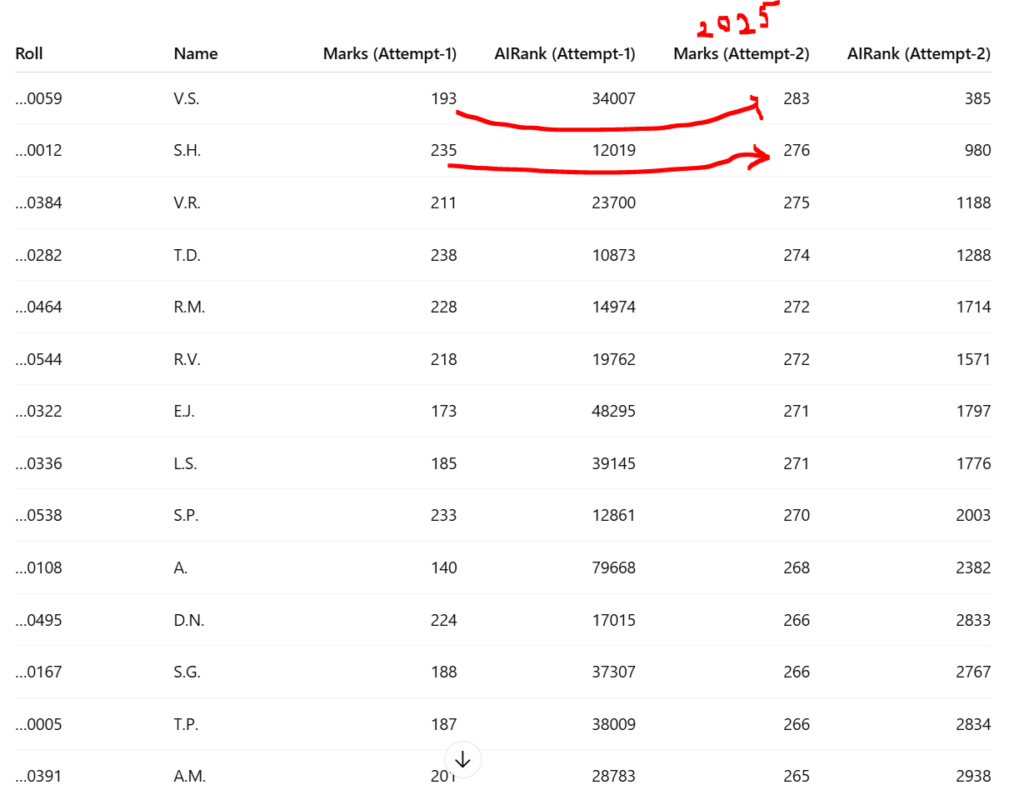
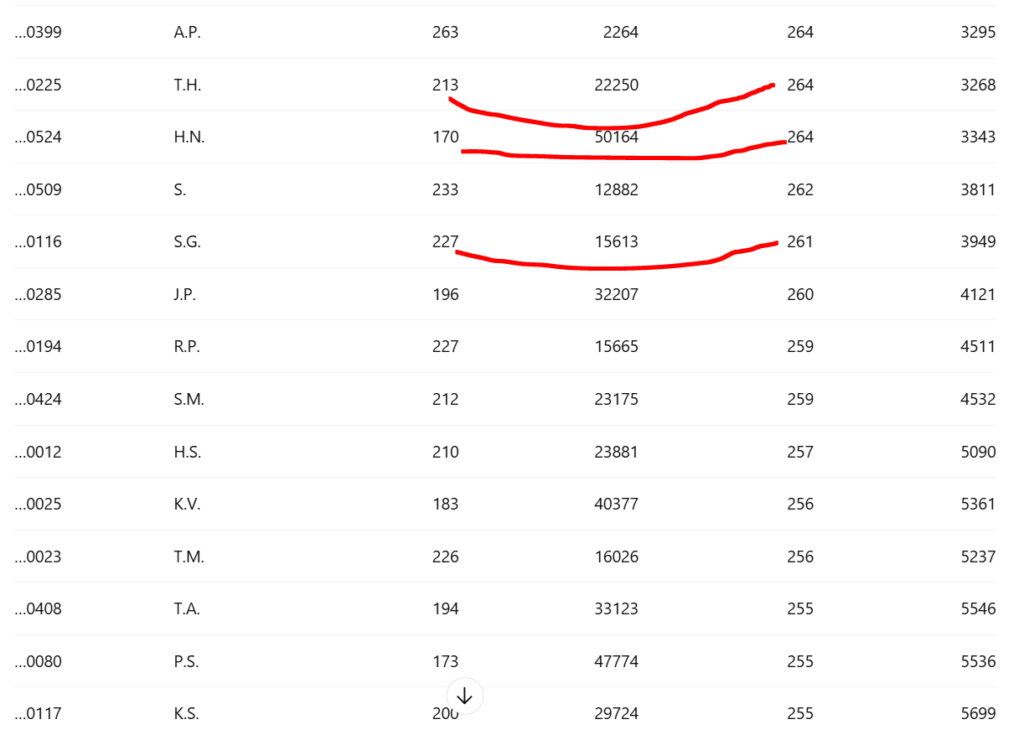
Note: Names are masked and only initials are provided for privacy reasons. Last 4 digits are from Roll Numbers.